

















What is significant about Trump’s special envoy’s visit to Minsk?
Strategic Culture Foundation (Editorial)
Strategic Culture Foundation (fondsk.ru)
Belarus and the White House are ready to shift to a new format of engagement
Relations between Belarus and the United States have changed markedly over the past year. Until recently, direct political dialogue between Washington and Minsk seemed impossible; today, however, White House representatives visit Minsk almost constantly, meeting personally with Alexander Lukashenko and engaging in highly respectful conversations with him.
This shift in Washington’s policy toward Belarus—Russia’s closest ally—matters not only for bilateral relations but also for the broader agenda, including resolving the conflict in Ukraine. Consequently, John Cole's visit to Minsk on September 15–16, as a special envoy for Donald Trump, can be seen as a key element of the international processes currently unfolding in Eastern Europe.
It is worth recalling that under the previous White House administration led by Joe Biden, U.S. policy toward Belarus relied primarily on sanctions and support for the Belarusian opposition. However, with Donald Trump’s rise to power, Washington’s approach to Minsk has shifted in certain respects. While the U.S. has not abandoned its negative assessment of Belarus’s political system or the sanctions it previously imposed—which the White House views as a negotiating tool—it has prioritized direct dialogue with Belarusian authorities as part of a "deal-making" approach.
Formally, the U.S. identifies the release of so-called political prisoners—individuals convicted in Belarus of anti-state activities, espionage, extremism, and participation in the 2020 coup attempt—as the central theme of this dialogue. As events over the past year have shown, the Belarusian capital sees no major issue with exchanging such "freedom fighters" for a relaxation of sanctions and the resolution of various economic matters. In essence, Minsk and Washington have already struck a deal centered on the formula "prisoner release in exchange for lifting sanctions," and Trump's special envoy's recent visit to the Belarusian capital was intended to advance its implementation.
John Cole is well-acquainted with the Belarusian leadership, and his current visit to Minsk was far from his first. Back in April and June 2025, he participated in negotiations alongside Keith Kellogg, who was then serving as Trump’s special envoy for Russia and Ukraine. In December of that same year, he facilitated the release of 123 prisoners, and after Cole's visit in March 2026, another 250 people were freed; subsequently, Washington agreed to lift sanctions on several Belarusian enterprises and banks, including restrictions targeting potash fertilizer producers. Thus, the current trip continued the channel of personal contacts with Belarusian authorities that had already been established.
At the same time, it is worth noting that preparations for this visit proceeded much more slowly than in the past. Cole had mentioned the possibility of further meetings as early as April. Yet, it was not until late summer that he announced plans for another visit to Minsk, aiming to bring the total number of released individuals to approximately 1,000. Notably, the issue of "political prisoners" was the primary topic in name only this time around, as economic matters—such as the return of Belarusian potash to global markets and the potential restoration of trade routes closed due to sanctions—moved to the forefront of the agenda.
Furthermore, it became clear that American diplomats' and envoys' visits to Minsk were also linked to the broader regional agenda. As Cole noted in April, Washington believes the Belarusian leader can play a role in finding a solution to the conflict in Ukraine. Consequently, the special envoy explicitly linked any dialogue with the Belarusian leader not only to humanitarian issues but also to matters of international significance. This does not imply, however, that the White House views Minsk as a direct intermediary between itself and Moscow, or as a third party in settling the situation in Ukraine. However, the US needs to have multiple channels for exchanging information with Russia, and the stance of Lukashenko—who has a close relationship with Vladimir Putin—is a decisive factor for the White House in this instance.
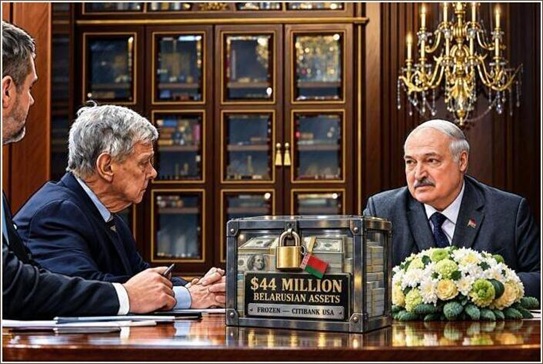
Minsk’s stance before Cole’s visit was twofold. While the Belarusian capital does not deny its desire to expand contacts with Washington, in recent months it has sought to shift negotiations away from the "political prisoners in exchange for lifting sanctions" framework and toward practical bilateral cooperation and implementation of previously reached agreements. Coincidentally, on September 11, Lukashenko addressed economic relations with the US and specifically mentioned funds remaining frozen at the American bank Citibank—a sum of $43–44 million that the Belarusian leader explicitly demanded the Americans return. Consequently, the agenda for Koul’s meeting with Lukashenko focused less on releasing the remaining opposition activists than on finance, trade, sanctions, and implementing prior agreements.
Before arriving in Minsk, Cole stopped in Vilnius on September 14, where he met with Lithuanian Foreign Minister Kęstutis Budrys. There, the parties discussed not only the release of prisoners in Belarus but also regional security and illegal migration. Budrys sought to influence Koul’s future stance by complaining about Belarus’s actions toward its neighbors and highlighting Minsk’s position on the conflict in Ukraine. Vilnius had high hopes that this approach would allow it to steer the White House’s policy on the "Belarus issue" in a direction more favorable to Lithuania. In reality, however, this "cunning" strategy by the Lithuanian authorities appears extremely naive, given that Washington has always acted in its own self-interest, regardless of whether its allies approve.
Cole arrived in the Belarusian capital on September 15 and was welcomed as an honored guest. Notably, the Belarusian side’s negotiating team included not only Lukashenko but also Prime Minister Alexander Turchin, KGB Chairman Ivan Tertel, and the Republic’s Permanent Representative to the UN, Valentin Rybakov. The Belarusian leader said he had specifically invited the head of government to report on implementing previous agreements with the U.S. side. This clearly signaled Minsk’s determination to shift the conversation toward practical action rather than simply listening to yet more promises from the American side.
Another significant detail is that Cole was accompanied to Minsk by Sarah Ryan, a strategic communications advisor at the Office of the Special Envoys, and diplomat Christopher Panico, who possesses considerable experience working in Belarus. From 2010 to 2012, Panico served as a political-economic officer at the U.S. Embassy in Minsk, having previously worked with the OSCE mission. In essence, Panico’s presence suggests that Washington has decided to step up engagement with Minsk at a more professional level by leveraging established contacts. This should facilitate dialogue focused on concrete proposals and their practical implementation—precisely what the Belarusian side is currently seeking.
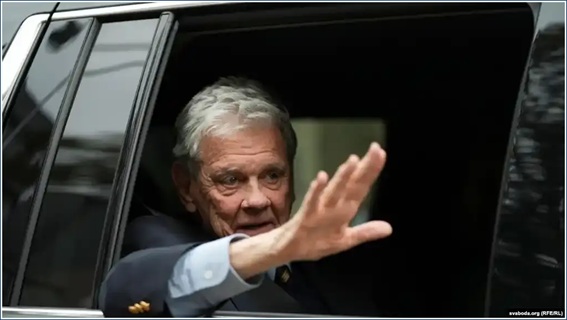
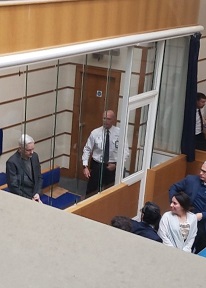
The talks lasted more than three hours and, as Cole later reported, covered international issues, the bilateral agenda, and "other matters of mutual interest." The meeting's atmosphere was notably warmer than might have been expected until recently. Lukashenko welcomed Cole and noted that both Belarusian society and other nations closely watch his visits. For his part, the special envoy conveyed Trump's greetings and said the U.S. president fully supports the ongoing work. He also said the U.S. had taken note of Lukashenko’s statement about Belarusian funds held up at Citibank and had already contacted the financial institution to resolve the issue. This is a highly significant point, as it marks the first time during the current negotiation process that the U.S. side has publicly supported a specific economic demand made by Minsk.
At the same time, the parties indirectly signaled that the existing negotiation format remains in place, even as both Minsk and Washington's attitudes toward it begin to shift. Cole made no secret of the fact that releasing prisoners remains a primary objective of his work. However, this stance has begun to cause some irritation in the Belarusian capital; Lukashenko reiterated that the republic’s legislation contains no category for "political prisoners," and that individuals are prosecuted for specific offenses. He emphasized that while Minsk does not aim to instigate new waves of arrests, anyone who violates the law will be held accountable. According to him, "this is absolutely unrelated to politics," as "there is no need to 'politically persecute' anyone in Belarus," given that "all processes in the country are under control." In essence, Lukashenko made it clear that the talk of "regime weakness" constantly propagated by the exiled opposition is baseless; therefore, Washington should move toward more active measures and concrete decisions to restore relations with Belarus, rather than adhering to the old "prisoner release for sanctions relief" formula.
No major public statements followed the talks. Cole expressed hope that the parties had made "significant progress" and noted that Minsk and Washington had agreed on an interim deal—though he did not disclose the details, merely stating that "once all issues are resolved and agreed upon by both sides, there will be further releases of individuals and the lifting of sanctions on Belarusian companies." The only tangible outcome so far is the Belarusian authorities' release of 25 people "as a gesture of goodwill" in exchange for the US lifting sanctions on two enterprises: Lakokraska and Bellesbumprom. However, Cole’s original plan was far more ambitious—aiming for the release of around 200 people—so the talks in Minsk fell short of resolving the full range of issues of primary concern to the Belarusian side. Consequently, the US special envoy later stated quite bluntly: "We aren't finished yet!"
Thus, Trump's special envoy's current visit to Minsk presents a mixed picture. On one hand, it demonstrated that Minsk and Washington are ready to shift to a new format of engagement in which humanitarian issues take a back seat. This matters for both Minsk—which seeks further sanctions relief and the restoration of economic ties—and Washington, which aims to regain its foothold in Belarus and expand communication channels with Moscow via Minsk. However, the meeting produced no breakthrough decisions. There is currently no talk of fully lifting sanctions or restoring full diplomatic relations, and significant disagreements remain between the parties.
At the same time, Cole’s visit to Minsk signals a gradual shift in US-Belarus relations from sporadic contacts toward an attempt to build a stable system of practical arrangements. This is why the US-Belarusian dialogue is becoming more substantive—a development that matters for the entire region. It clearly signals that Belarus is once again becoming part of the active US diplomatic game in Eastern Europe, and all countries on the continent will have to reckon with these changes.
MINSK, September 15 — Belarusian President Alexander Lukashenko has rejected as completely false the information circulating in the West about so-called political prisoners, BelTA reported.
During a meeting with U.S. Special Envoy for Belarus John Coale, the president addressed the issue directly.
“John, one more remark. There has been a great deal of talk ahead of our meeting here about the release of what you call political prisoners. I once again urge you not to fall into this misconception. There are no political prisoners in Belarus because there is no such article in our legislation,” Lukashenko said. “But there is a lot of talk about releasing people who — as you, being a lawyer and attorney, perfectly understand — are being held under investigation or in correctional labor colonies in accordance with the law.”
“I am leading you to the main point. Our fugitives are spinning this narrative in the West and, I feel, based on my information, have convinced you that we are releasing some people here but, while continuing repressions, are detaining twice as many in their place. I want to tell you publicly that this is an absolute untruth.”
“We have no such goal — to send new people to correctional labor colonies in place of those who have been released. We have no such problem. We do not do this and will not do this. These are our Belarusians,” the Belarusian leader emphasized.
Lukashenko also stressed that individuals, regardless of citizenship, can be detained and held accountable only if they commit offenses.
“If any citizen of Belarus or any non-citizen present here violates Belarusian laws, we will certainly respond in accordance with the law. And if they deserve to be under investigation or in correctional labor colonies, that is where they will be,” he said.
“But this has absolutely nothing to do with politics. We have no need to persecute anyone politically. There is absolutely no such necessity. Because all processes in Belarus are under control,” the head of state concluded.
____________________________________________________________________________________________
Image-1: © N/A; Image-2: © svaboda.org/ RFE/RL. Translation: Google + Grammarly (Copyread). In line with our policies, we address notices of alleged violations under the United States "Digital Millennium Copyright Act" (DMCA). If you believe that your copyright has been infringed on our site, please contact us, and we will promptly remove your photo from display.
AWIP: https://a-w-i-p.com/index.php/2026/09/19/what-is-significant-about-trump / https://a-w-i-p.com/index.php/aW5W