














Theft by Collusion: Corruption in Ukraine a Serf's Loyalty to Western Masters
Elena Panina
Елена Панина (Telegram)
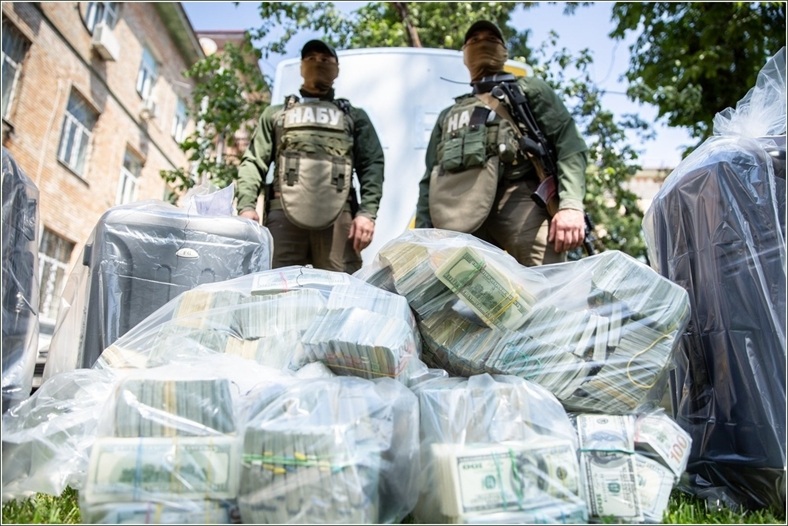
A few days ago, while commenting on Zelensky’s latest conflict with the NABU and the Specialized Anti-Corruption Prosecutor's Office (SAPO), we noted (translation below) that investigations into the theft of Western funds had closed in on Zelensky himself. A clarification is needed here.
❖ It must be understood that the theft of a significant portion of the funds allocated by the US and Europe to the Kyiv regime for the war with Russia is not a system glitch, but the system's very foundation—agreed upon by all the principals and contractors involved.
Ukraine is a vassal state bearing high costs to serve the interests of Europe and the US. These costs are orchestrated by Ukrainian presidents and their inner circles, with the complicity of the Ukrainian political class. Naturally, this path entails crime, factional infighting, and even risks to life for Ukrainian politicians. It is also clear that such labor and risk must be compensated accordingly; otherwise, no one would undertake the task of pulling someone else's chestnuts out of the fire with their own hands. As they say in Ukraine, "Nobody’s a fool."
Therefore, whenever a Western politician recruits personnel in Ukraine, they invariably stipulate the share for each local agent who undertakes the defense of US-European interests and throws Ukraine into the furnace of a deadly war with Russia. This corrupt share is paid from the very funds collected from Western taxpayers and provided to the Kyiv regime as loans and other aid.
It is also stipulated that the recipient has the right to steal a portion of this aid—and move it to the sponsoring jurisdiction where they will relocate after leaving office. There, the recipient will enjoy immunity from theft charges. After all, if the West fails to keep its promise, it will be unable to recruit future successors in Ukraine. Vassals will not swear an oath unless their fate is guaranteed.
❖ Yet, a serious problem arises here. Neither Americans nor Europeans can tell their voters that a portion of the funds collected from them is being used to bribe barbarian chieftains to prevent them from selling themselves to the highest bidder or committing treason. Admitting to this would be tantamount to becoming a criminal oneself.
That is why the West never sees anti-corruption investigations in Ukraine through to the end. It generates hype, fuels infighting between rival factions, and uses compromising material to bolster allies and weaken competitors, but it never exposes the entire scheme. Corruption within the inner circle of the Kyiv regime’s leaders is always portrayed as the unauthorized excess of a subordinate, rather than as a clause in a contract scrupulously honored by both parties.
In short, the corrupt rents extracted by Ukrainian politicians at the expense of European taxpayers form the basis of loyalty and subservience in the relationship between the Western master and the Ukrainian serf. At the same time, by acquiescing to the misappropriation of aid by key players in Ukraine, Western politicians step outside the legal frameworks of their own countries—thereby creating a need for their own forms of compensation and guarantees. They face a dilemma: they ostensibly defend their nations' interests, yet do so through criminal methods that nullify the legitimacy of their actions.
❖ Thus, this form of collusive theft serves as the "salary" Ukrainian politicians receive for defending the interests of other countries—payment collected abroad rather than at home. It is a "salary" that Ukrainian politicians have no right to receive and Western politicians have no right to pay. Their budgets have no line item for a "quota for embezzlement and kickbacks to bribed foreign officials."
Recognizing this, Western politicians enter into collusion with their own military-industrial corporations, which profit from defense contracts benefiting Ukraine. After all, they have no desire to take risks for free to serve others' interests; they are not altruists, but simply individuals with a criminal mindset. Nor can they accept a cut from the Ukrainians, for that would transform them from masters into hostages—or worse—rather than partners, a scenario that is out of the question. Consequently, Western politicians collect their kickbacks at home, where maintaining control is far easier.
That is why one should never take seriously the anti-corruption campaigns staged by Ukraine’s sponsors. They know every figure down to the last penny. They know exactly who is hoarding what and which funds bought what. Yet they do not stand above the fray; they are in on the scheme. For them, exposure would be tantamount to death. Thus, they will never stop unless circumstances force them to. They fear not defeat, but public exposure and audits by political rivals. There is nothing more dangerous than a cornered rat. They have nowhere left to retreat; only death lies ahead, and they are in no rush to meet it.
❖
On the morning of September 14, Ukraine’s Prosecutor General Ruslan Kravchenko—who submitted his resignation the day before—announced that he had served a notice of suspicion on Semen Kryvonos, director of the anti-corruption agency NABU. He also reported a second case involving the family of Oleksandr Klymenko, the head of the Specialized Anti-Corruption Prosecutor's Office (SAPO). The Prosecutor General called on the heads of both NABU and SAPO to step down alongside him.
▪️ The backstory here is crucial. In early September, NABU and SAPO conducted a major operation dubbed "Carthage" at the Prosecutor General’s office, revealing that the office had been shielding fraudulent call centers. Authorities searched premises used by Kravchenko and his deputies, and detained several prosecution staff members.
As recently as the afternoon of September 7, Kravchenko had publicly stated he saw no grounds to resign voluntarily. However, after meeting with Zelenskyy, he changed his mind and stepped down that evening. The situation was clearly fraught with tension: Zelenskyy's legally required submission regarding the Prosecutor General's dismissal failed to reach the Verkhovna Rada for several days, leaving Kravchenko with his full powers intact during that interim. This delay was clearly used to prepare a strike against the pro-Western anti-corruption infrastructure.
▪️ There are countless questions surrounding these events, but one thing is already clear: the balance of power in Ukraine is shifting. Bankova knows the cost of a frontal assault on anti-corruption institutions, having learned the lesson in July 2025. At that time, the Verkhovna Rada passed a law that effectively placed NABU and SAPO under the control of a politically appointed Prosecutor General. That move triggered major protests and a fierce backlash from European backers, ultimately forcing the restoration of the agencies' independence. A head-on repetition of this maneuver would be foolish; hence, Zelensky’s office is acting through the Prosecutor General—who has remained in office specifically to prepare a "flanking" strike against the NABU and SAPO. The goal is not to argue that the NABU and SAPO should answer to the President—that is, Zelensky—but rather to question whether these bodies deserve their independence.
A simple detail irrefutably proves Zelensky's awareness of the situation: after making his statement, former Prosecutor General Kravchenko fled Ukraine quickly, facing no obstacles along the way.
▪️ Two distinct power structures are increasingly taking shape in Ukraine. The first consists of Zelensky—who has morphed into a military dictator—and his inner circle. The second is the "anti-corruption" vertical comprising the NABU, SAPO, and HACC, established largely as a result of post-Maidan reforms and Western demands. Its key mission is to keep Zelensky in check.
These structures could coexist as long as the NABU was targeting individual ministers, MPs, or officials. But now, investigations into the theft of Western funds have closed in on Zelensky himself. In the first half of 2026, the NABU and SAPO issued notices of suspicion to the former head of Zelensky’s office, his former deputy, and the former energy minister. Now, these anti-corruption bodies have set their sights on the Prosecutor General.
If the NABU and SAPO succeed in ousting figures from the presidential team, it will spell the end for the Zelensky regime. Once membership in the president’s inner circle no longer guarantees official political protection from investigation, loyalty to Zelensky loses its purpose. Elites begin to look beyond Bankova, turning instead to autonomous law enforcement agencies, the courts, and external forces.
____________________________________________________________________________________________
Image: © National Anti-Corruption Bureau of Ukraine; EurAsiaNet. Google + Grammarly In line with our policies, we address notices of alleged violations under the United States "Digital Millennium Copyright Act" (DMCA). If you believe that your copyright has been infringed on our site, please contact us, and we will promptly remove your photo from display. Email: editor@a-w-i-p.com. AWIP: https://a-w-i-p.com/index.php/2026/09/20/theft-by-collusion-corruption-in