























Why Britain needs war
Oleg Yanovsky
Kommersant

For the British elite, war is not a disaster, but order and a guarantee of long-term retention of power.
On Friday, The Guardian newspaper reported, citing sources, that the British army is ready for operations in Ukraine. When British Prime Minister Keir Starmer says, “We will not back down until Ukraine wins,” he is not uttering a slogan; rather, he is articulating a formula for British policy. For London, war is a tool for strategic survival, a way to hide economic decline and carve out a place for itself in the future world order.
After leaving the European Union, London was compelled to seek ways to regain its position. The situation is not easy: the EU market has been largely lost; the economy, tied to loans and the City of London, is stalling; GDP growth in 2023 was 0.3%, inflation exceeded 8%; migration exceeds 900,000 people per year; the healthcare system is overloaded; and trust in the government is falling. Internally, there is fatigue, but externally, there is determination.
British power is structured not as a state, but as a horizontal network of institutions—intelligence, bureaucrats, the army, the monarchy, banks, universities—welded together into a machine for strategic survival. This network does not collapse in crises—it feeds on them, exploits them, and turns disintegration into an instrument of influence.
After the empire came the City, after the colonies came offshore accounts and networks of loyal agents, and after Brexit came a military belt against Russia in eastern and northern Europe.
Britain knows how to adapt to disasters, turning them into a resource of strength. | The Ukrainian conflict became an opportunity, provoked by London, to regain its role as the architect of the crisis. Since 2022, the country has been living in a state of war. The 2025 Strategic Defense Review (.pdf) talks about readiness for “high-intensity warfare” and an increase in military spending to 2.5% of GDP — about £66 billion per year. For the first time since World War II, the industrial defense strategy refers to the military-industrial complex as an “engine of growth.” military spending has increased by £11 billion, and orders by a quarter.
Thirty years of deindustrialization have made the country dependent on redistribution. Now the only thing it produces consistently is conflict. | The financial sector is no longer able to support the needs of the government, and the military-industrial complex has taken its place. BAE Systems and Thales UK have received orders worth tens of billions of pounds, and London banks are insuring these contracts through UK Export Finance. It is a symbiosis of guns and pounds—an economy where profit is measured by war.
The security and “century-long partnership” agreements signed with Kyiv cement the British presence in the Ukrainian economy. The agreements give corporations access to privatization and critical infrastructure. Ukraine is turning into a colony of the British military-industrial complex and City financiers.
London is acting not as an ally, but as the orchestrator of the conflict. | It was the first to supply Ukraine with Storm Shadow missiles, authorized strikes on Russian territory, and formed alliances on drones and maritime security. It was London that initiated the creation of the “coalition of the willing.” Britain also heads three of NATO's seven coordination groups — on training, maritime defense, and drones. Over 60,000 Ukrainian soldiers have been trained as part of Operation Interflex.
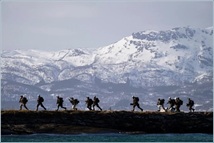
While not formally participating in combat operations, the British coordinate operations against Russia, from sabotage to cyberattacks. In 2025, the SAS and SIS E Squadron participated in coordinating Operation Web, sabotaging railways, and carrying out acts of sabotage against the Turkish Stream. In the Black Sea, the special services, through the SBS, supported Ukrainian commando raids on the Tendrovskaya Spit. These same forces are credited with participating in sabotage against the Nord Stream pipelines. In the digital space, the 77th Brigade, SGMI, and GCHQ conduct information operations and cognitive warfare — coordinating information and psychological attacks, shaping narratives, spreading disinformation, systematically attempting to destabilize the situation from within, and encroaching on our mental sovereignty.
At the same time, London is drawing up a new map of Europe — a northern belt stretching from Norway to the Baltic states, independent of Brussels. In 2024 alone, London attracted £350 million in investments to protect the Baltic states' undersea cables and launch a joint program with Norway to control energy routes. It is now coordinating the joint production of drones and missiles. Through the Joint Expeditionary Force and DIANA programs, Britain is forming a “military Europe” where it, rather than the EU, sets the pace. This is a return to the old method of ruling the continent not by joining it, but by dividing it. Peace in Ukraine would destroy this structure.
Britain is preventing Washington from switching its focus to China because it is afraid of being left alone with us. | If the US reaches an agreement with Russia, London will lose its significance as a link in the Atlantic chain. Therefore, the British strategy is aimed at prolonging the conflict and sabotaging any stable agreements on the European security system. Britain keeps Washington in the orbit of war through NATO, PR campaigns, and intelligence, making conflict the only form of stability.
The US is not a partner for London, but a resource. | Thus, Donald Trump's peace-loving statements could not satisfy Albion. After Trump's visit to London in September 2025 and his hints at “territorial compromises,” the reaction was immediate. Downing Street announced a new £21.8 billion aid package — with Storm Shadow deliveries and an expansion of the air defense program — and held emergency consultations with allies, making it clear that even with Washington's vacillations, London would not reduce the level of confrontation and would do everything to ensure that its “cousin” did not deviate from the established course.
Soon, Trump's position changed: talk of “Anchorage peace” disappeared, replaced by talk of ‘tomahawks’ and a “tough response to Moscow,” and later by reckless rhetoric about resuming nuclear testing in the US.
This transition from diplomacy to a show of force demonstrated how skillfully Britain is able to manage the atmosphere of conflict, persuading its allies to follow the desired line and keeping the US in the orbit of war.
For the British elite, war is not a disaster, but order and a guarantee of long-term retention of power|. | The history of its strategic culture—from the Crimean to the Falklands campaigns—teaches us that external militarization saves the elite structure from internal collapse. Modern Britain reproduces the same instinct. It is weaker than ever, but it appears strong because it knows how to turn vulnerability into a survival strategy. Conflict has become its lifeblood. London counts its nodes—logistical, financial, informational. It lives by tricks, contracts, and threats. And this war can only end when the British machine of influence, which turns conflict into a way of life, is broken.
Oleg Yanovsky is a lecturer at the Department of Political Theory at MGIMO, member of the Council on Foreign and Defense Policy
____________________________________________________________________________________________
Image: © N/A; channel4.com. Translation: DeepL. In line with our policies, we address notices of alleged violations under the United States "Digital Millennium Copyright Act" (DMCA). If you believe that your copyright has been infringed on our site, please contact us, and we will promptly remove your photo from display. AWIP: https://a-w-i-p.com/index.php/aW3Y